

Spotlight on a Standard: EN 14325

PPE standards exist to define minimum performance requirements, and how protective clothing is tested, classified, and certified. Most professionals are familiar with:

Product standards — which define the performance requirements a garment must meet to achieve certification.

Test standards — which describe how specific materials or garments are tested under controlled conditions.

These standards form the foundation of PPE selection and certification.

But what about EN 14325?

It’s one of the most important—and often most misunderstood—standards in chemical protective apparel.

That’s because EN 14325 doesn’t fit neatly into either of those categories.

You can’t certify a garment to EN 14325, And it isn’t simply another test method.

Instead, EN 14325 acts as something different: a reference framework that helps bring consistency, clarity, and meaning to chemical protective clothing performance data.
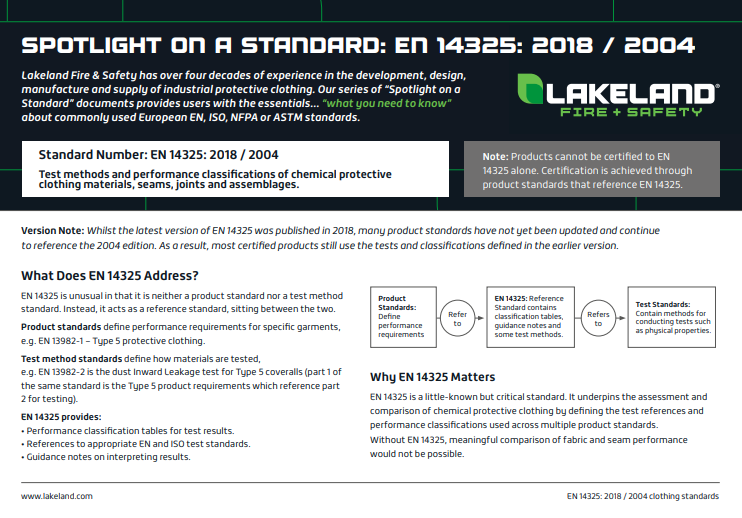
“Lakeland Fire & Safety infographic titled ‘Spotlight on a Standard: EN 14325: 2018 / 2004.’ The document explains the EN 14325 standard for chemical protective clothing, including test methods, performance classifications, certification notes, and why the standard matters for evaluating protective clothing materials, seams, and assemblies.”

Yes, it includes certain test methods. But its real importance lies elsewhere.

EN 14325 provides the classification tables, performance levels, and interpretive guidance used to evaluate test results generated by other standards—including well-known test methods such as EN 6529 for chemical permeation resistance.
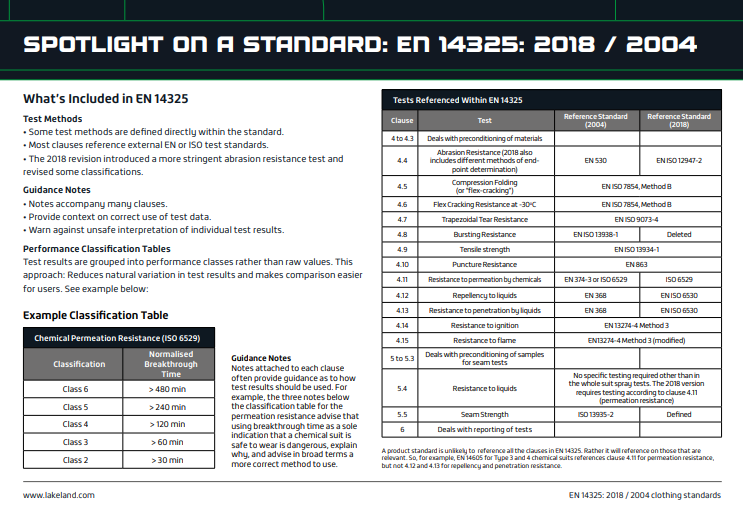
“Second page of Lakeland Fire & Safety’s ‘Spotlight on a Standard: EN 14325: 2018 / 2004’ document. The page outlines what is included in EN 14325, including test methods, guidance notes, and performance classification tables for chemical protective clothing. It features an example classification table for chemical permeation resistance based on ISO 6529 breakthrough times and a detailed chart listing EN 14325 test clauses, corresponding EN and ISO reference standards, and testing categories such as abrasion resistance, tensile strength, puncture resistance, liquid repellency, flame resistance, and seam strength.”

In other words, while a test standard tells you how to generate data, EN 14325 helps you understand what that data actually means:

  • Does a breakthrough time of a certain number of minutes represent low performance… or high protection?
  • What performance class does that result fall into?
  • How should one material be compared against another?


EN 14325 provides the framework that answers those questions.

And that makes it far more than a technical reference—it becomes an essential tool for anyone responsible for selecting, specifying, or assessing certified chemical protective clothing.

Because in chemical protection, test data alone doesn’t protect workers. Understanding what that data means does.

Contact us to discuss how EN 14325 applies to your PPE program and how a better understanding of performance data can support safer protection decisions.


Chemical Safe-Wear Time Report

Our Safe-Wear Time assessment indicates an effective maximum period a suit may be worn in a specific application before possible leakage may result in harm to the wearer, based on a total inward leakage derived from both fabric permeation and possible suit inward leakage, on the parameters of your application (such as temperature) and on the defined toxicity thresholds (TL’s shown in the tab above) for the chemical.

Facebook
Twitter
LinkedIn
Print
Email

Related Posts

Family walking through a doorway in the background as lab tech looks into the camera, protected by Lakeland Fire + Safety PPE
Protect What Matters Most: Proper PPE Use Can Save Your Family

Protect Loved Ones from Secondary Contamination with Proper PPE Personal Protective Equipment (PPE) is a crucial Barrier in safeguarding individuals...

Mining carts in underground tunnel
Worker Safety in Metallurgy & Non-Ferrous Metals: Lakeland Protective Clothing Safety Guide

In the world of industrial production, the metallurgy and non-ferrous metals industries are crucial, providing essential raw materials for countless...

What can we help you find?

Find a Location

View Locations

Find a Chemical

Search Chemicals

Find a Download

Document Finder