

Las normas sobre EPI tienen por objeto definir los requisitos mínimos de rendimiento, así como el modo en que se somete a ensayo, clasifica y certifica la ropa de protección. La mayoría de los profesionales están familiarizados con:
• Normas de producto: definen los requisitos de rendimiento que debe cumplir una prenda para obtener la certificación.
• Normas de ensayo: describen cómo se someten a ensayo determinados materiales o prendas en condiciones controladas.
Estas normas constituyen la base para la selección y certificación de los equipos de protección individual.
¿Y qué hay de la norma EN 14325?
Es una de las normas más importantes —y, a menudo, más malinterpretadas— en el ámbito de la ropa de protección química.
Esto se debe a que la norma EN 14325 no encaja claramente en ninguna de esas dos categorías.
No se puede certificar una prenda según la norma EN 14325, y no se trata simplemente de otro método de ensayo.
En cambio, la norma EN 14325 cumple una función diferente: es un marco de referencia que contribuye a aportar coherencia, claridad y sentido a los datos sobre el rendimiento de la ropa de protección química.
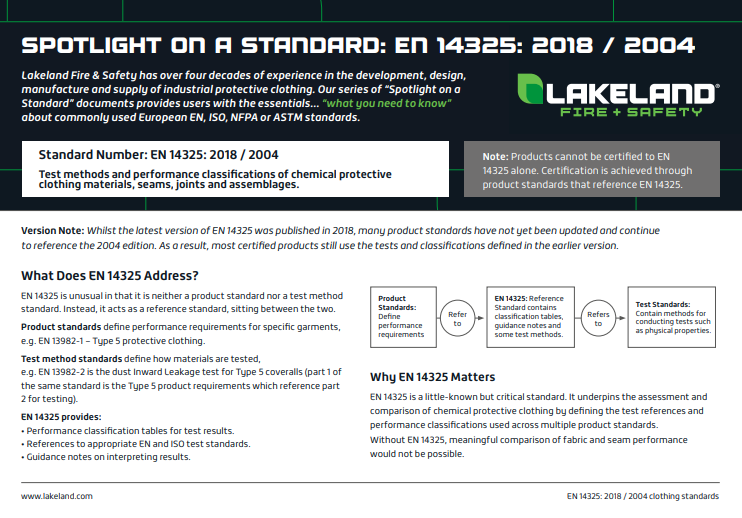
Sí, incluye ciertos métodos de ensayo. Pero su verdadera importancia radica en otra cosa.
La norma EN 14325 establece las tablas de clasificación, los niveles de rendimiento y las orientaciones interpretativas que se utilizan para evaluar los resultados de los ensayos obtenidos con arreglo a otras normas, incluidos métodos de ensayo tan conocidos como el de la norma EN 6529 para la resistencia a la permeación química.
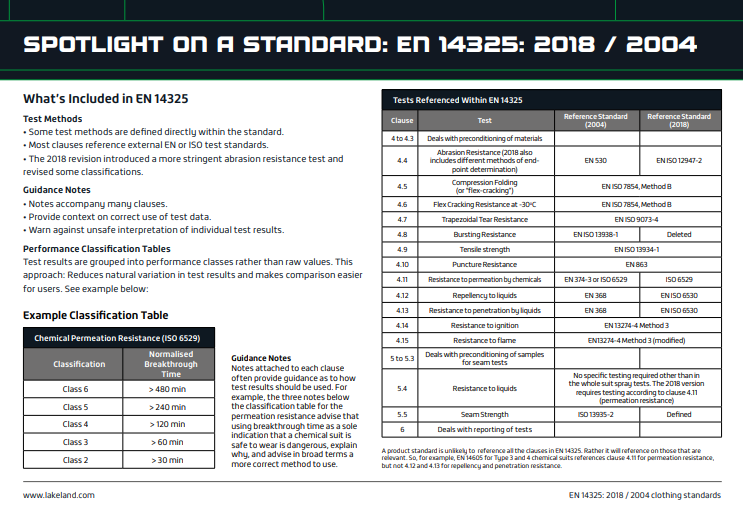
En otras palabras, mientras que una norma de ensayo indica cómo generar datos, la norma EN 14325 ayuda a comprender qué significan realmente esos datos:
- ¿Un tiempo de penetración de un determinado número de minutos indica un bajo rendimiento… o una alta protección?
- ¿En qué categoría de rendimiento se incluye ese resultado?
- ¿Cómo se debe comparar un material con otro?
La norma EN 14325 ofrece el marco que da respuesta a esas preguntas.
Y eso lo convierte en mucho más que una simple referencia técnica: se convierte en una herramienta indispensable para cualquier persona encargada de seleccionar, especificar o evaluar ropa de protección química certificada.
Porque, en materia de protección química, los datos de las pruebas por sí solos no protegen a los trabajadores. Lo que sí los protege es comprender lo que significan esos datos.
Póngase en contacto con nosotros para analizar cómo se aplica la norma EN 14325 a su programa de EPI y cómo un mejor conocimiento de los datos de rendimiento puede ayudarle a tomar decisiones más seguras en materia de protección.