

Les normes relatives aux EPI ont pour but de définir les exigences minimales de performance, ainsi que les modalités de test, de classification et de certification des vêtements de protection. La plupart des professionnels connaissent bien :
• Normes relatives aux produits — qui définissent les exigences de performance auxquelles un vêtement doit satisfaire pour obtenir la certification.
• Normes d'essai — qui décrivent la manière dont certains matériaux ou vêtements sont testés dans des conditions contrôlées.
Ces normes constituent la base du choix et de la certification des EPI.
Mais qu'en est-il de la norme EN 14325?
C'est l'une des normes les plus importantes — et souvent les plus mal comprises — dans le domaine des vêtements de protection chimique.
C'est parce que la norme EN 14325 ne correspond clairement à aucune de ces deux catégories.
On ne peut pas certifier un vêtement selon la norme EN 14325, et il ne s'agit pas simplement d'une méthode d'essai supplémentaire.
Au contraire, la norme EN 14325 remplit une fonction différente : celle d'un cadre de référence qui contribue à apporter cohérence, clarté et pertinence aux données relatives aux performances des vêtements de protection chimique.
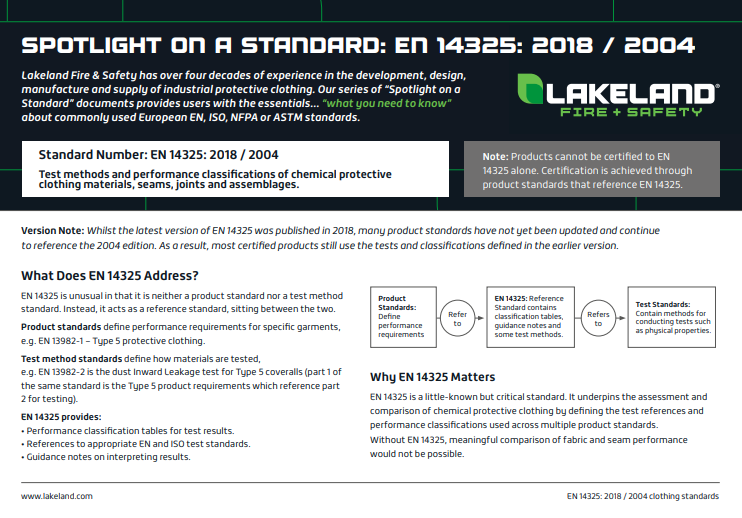
Oui, il comprend certaines méthodes d'essai. Mais son véritable intérêt réside ailleurs.
La norme EN 14325 fournit les tableaux de classification, les niveaux de performance et les indications d'interprétation utilisés pour évaluer les résultats d'essais obtenus selon d'autres normes, y compris des méthodes d'essai bien connues telles que la norme EN 6529 relative à la résistance à la perméation chimique.
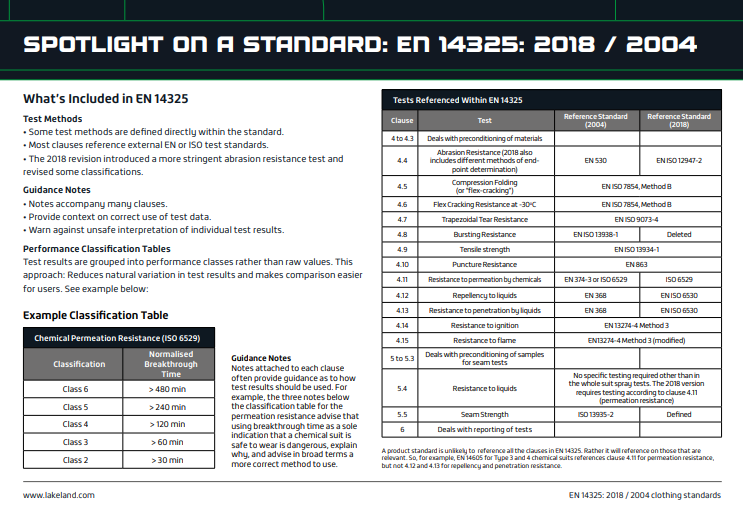
En d'autres termes, alors qu'une norme d'essai vous indique comment générer des données, la norme EN 14325 vous aide à comprendre ce que ces données signifient réellement :
- Un temps de pénétration de quelques minutes est-il synonyme de faible performance… ou de protection élevée ?
- À quelle classe de performance ce résultat correspond-il ?
- Comment comparer un matériau à un autre ?
La norme EN 14325 fournit le cadre permettant de répondre à ces questions.
Cela en fait bien plus qu'un simple ouvrage de référence technique : c'est un outil indispensable pour toute personne chargée de sélectionner, de définir les spécifications ou d'évaluer des vêtements de protection chimique certifiés.
Car dans le domaine de la protection chimique, les données d'essai ne suffisent pas à elles seules à protéger les travailleurs. C'est la compréhension de ces données qui permet de les protéger.
Contactez-nous pour discuter de la manière dont la norme EN 14325 s'applique à votre programme d'EPI et de la façon dont une meilleure compréhension des données de performance peut vous aider à prendre des décisions plus sûres en matière de protection.