

PSA-Normen dienen dazu, Mindestanforderungen an die Leistungsfähigkeit festzulegen und zu regeln, wie Schutzkleidung geprüft, klassifiziert und zertifiziert wird. Den meisten Fachleuten sind folgende Normen bekannt:
• Produktnormen – diese legen die Leistungsanforderungen fest, die ein Kleidungsstück erfüllen muss, um zertifiziert zu werden.
• Prüfnormen – die beschreiben, wie bestimmte Materialien oder Kleidungsstücke unter kontrollierten Bedingungen geprüft werden.
Diese Normen bilden die Grundlage für die Auswahl und Zertifizierung von PSA.
Aber was ist mit der Norm EN 14325?
Es handelt sich um eine der wichtigsten – und oft am meisten missverstandenen – Normen im Bereich der Chemikalienschutzkleidung.
Das liegt daran, dass die Norm EN 14325 in keine dieser beiden Kategorien eindeutig passt.
Ein Kleidungsstück kann nicht nach EN 14325 zertifiziert werden, und es handelt sich dabei nicht einfach nur um ein weiteres Prüfverfahren.
Stattdessen erfüllt die Norm EN 14325 eine andere Funktion: Sie dient als Referenzrahmen, der dazu beiträgt, den Leistungsdaten für chemische Schutzkleidung Konsistenz, Klarheit und Aussagekraft zu verleihen.
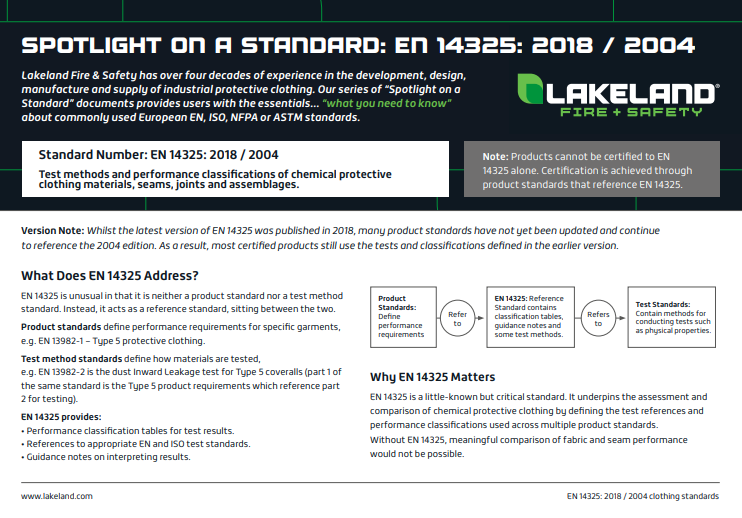
Ja, es enthält bestimmte Prüfverfahren. Aber seine eigentliche Bedeutung liegt woanders.
Die Norm EN 14325 enthält Klassifizierungstabellen, Leistungsstufen und Auslegungshilfen, die zur Bewertung von Prüfergebnissen herangezogen werden, die nach anderen Normen ermittelt wurden – darunter bekannte Prüfverfahren wie die Norm EN 6529 zur Beständigkeit gegen chemische Permeation.
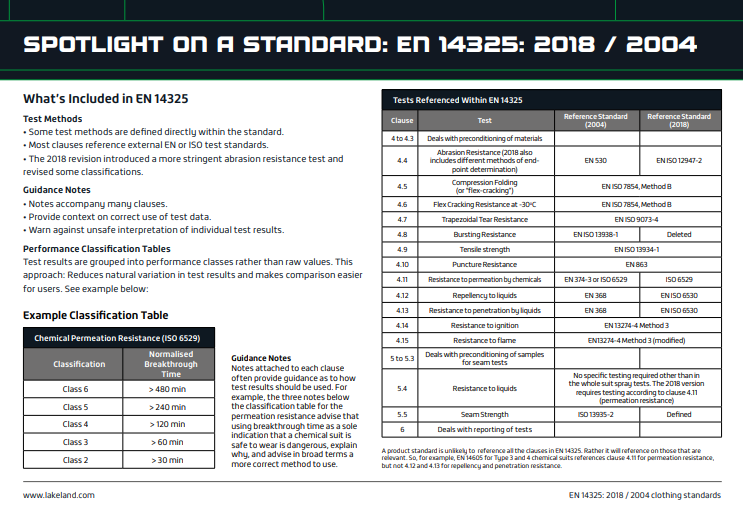
Mit anderen Worten: Während eine Prüfnorm Ihnen vorschreibt, wie Daten zu generieren sind, hilft Ihnen die Norm EN 14325 dabei, zu verstehen, was diese Daten tatsächlich bedeuten:
- Bedeutet eine Durchbruchzeit von einer bestimmten Anzahl von Minuten eine geringe Leistung … oder einen hohen Schutz?
- In welche Leistungsklasse fällt dieses Ergebnis?
- Wie sollte man ein Material mit einem anderen vergleichen?
Die Norm EN 14325 bietet den Rahmen, der diese Fragen beantwortet.
Und damit ist es weit mehr als nur ein technisches Nachschlagewerk – es wird zu einem unverzichtbaren Hilfsmittel für alle, die für die Auswahl, Spezifizierung oder Bewertung zertifizierter Chemikalienschutzkleidung zuständig sind.
Denn im Bereich des Chemikalienschutzes schützen Testdaten allein die Arbeitnehmer nicht. Erst das Verständnis dieser Daten tut dies.
Kontaktieren Sie uns, um zu besprechen, wie die Norm EN 14325 auf Ihr PSA-Programm anzuwenden ist und wie ein besseres Verständnis der Leistungsdaten zu sichereren Entscheidungen beim Arbeitsschutz beitragen kann.