
Spotlight on a Standard: EN 14325

PPE standards exist to define minimum performance requirements, and how protective clothing is tested, classified, and certified. Most professionals are familiar with:

Product standards — which define the performance requirements a garment must meet to achieve certification.

Test standards — which describe how specific materials or garments are tested under controlled conditions.

These standards form the foundation of PPE selection and certification.

But what about EN 14325?

It’s one of the most important—and often most misunderstood—standards in chemical protective apparel.

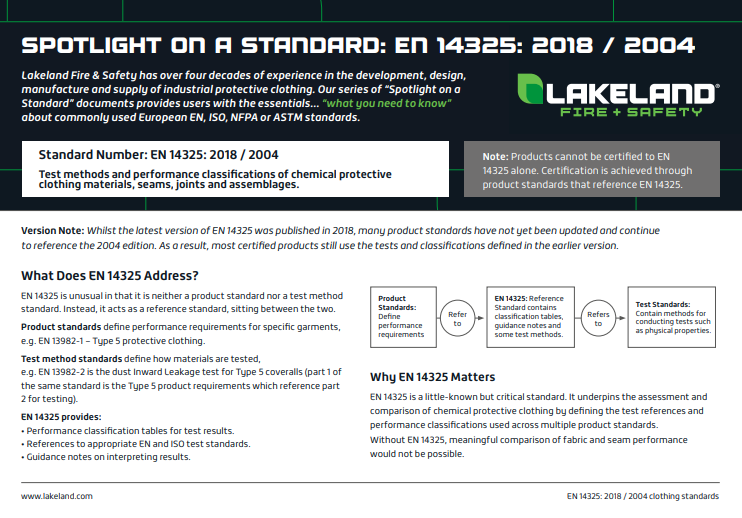
That’s because EN 14325 doesn’t fit neatly into either of those categories.

You can’t certify a garment to EN 14325, And it isn’t simply another test method.

Instead, EN 14325 acts as something different: a reference framework that helps bring consistency, clarity, and meaning to chemical protective clothing performance data.

“Lakeland Fire & Safety infographic titled ‘Spotlight on a Standard: EN 14325: 2018 / 2004.’ The document explains the EN 14325 standard for chemical protective clothing, including test methods, performance classifications, certification notes, and why the standard matters for evaluating protective clothing materials, seams, and assemblies.”

Yes, it includes certain test methods. But its real importance lies elsewhere.

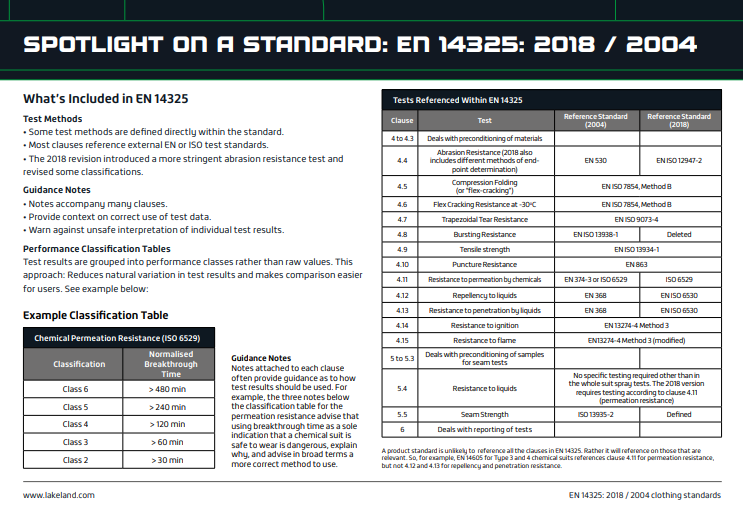
EN 14325 provides the classification tables, performance levels, and interpretive guidance used to evaluate test results generated by other standards—including well-known test methods such as EN 6529 for chemical permeation resistance.

“Second page of Lakeland Fire & Safety’s ‘Spotlight on a Standard: EN 14325: 2018 / 2004’ document. The page outlines what is included in EN 14325, including test methods, guidance notes, and performance classification tables for chemical protective clothing. It features an example classification table for chemical permeation resistance based on ISO 6529 breakthrough times and a detailed chart listing EN 14325 test clauses, corresponding EN and ISO reference standards, and testing categories such as abrasion resistance, tensile strength, puncture resistance, liquid repellency, flame resistance, and seam strength.”

In other words, while a test standard tells you how to generate data, EN 14325 helps you understand what that data actually means:

  • Does a breakthrough time of a certain number of minutes represent low performance… or high protection?
  • What performance class does that result fall into?
  • How should one material be compared against another?


EN 14325 provides the framework that answers those questions.

And that makes it far more than a technical reference—it becomes an essential tool for anyone responsible for selecting, specifying, or assessing certified chemical protective clothing.

Because in chemical protection, test data alone doesn’t protect workers. Understanding what that data means does.

Contact us to discuss how EN 14325 applies to your PPE program and how a better understanding of performance data can support safer protection decisions.

化学品安全防护时效报告

我们的安全穿着时间评估基于以下参数:面料 、防护服可能的内向渗漏量、应用环境参数(如温度)以及化学品的定义毒性阈值(见上方标签页所示毒性阈值),从而确定防护服在特定应用场景中可安全穿着的有效最大时长——在此之后,可能出现的渗漏将对穿着者造成危害。

Facebook
Twitter
领英
打印
电子邮件

相关文章

背景中一家人正穿过门廊,实验室技术员凝视镜头,身着雷克兰 安全防护装备。
守护至关重要的安全:正确使用个人防护装备能保护您的家人

使用适当的个人防护装备(PPE)保护亲人免受二次污染个人防护装备(PPE)是保障个人安全的关键屏障...

矿车在地下隧道中
冶金业 有色金属行业工人安全:雷克兰 指南

在工业生产领域,冶金业 有色金属工业至关重要,为无数行业提供着不可或缺的原材料...

我们能帮你找到什么?

查找地点

查看地点

查找化学品

搜索化学品

查找下载

文件搜索器